September 6, 2026
How Collaboration Improved a Story from 3.6 to 4.7
A case study in using named AI collaborators, section-level edits, review gates, and automatic assessment to improve a generated story without losing continuity.
How Collaboration Improved a Story from 3.6 to 4.7
The useful question was not whether an AI could generate a story. It could. The useful question was whether a story could be improved by a group of agents without turning revision into a pile of competing rewrites.
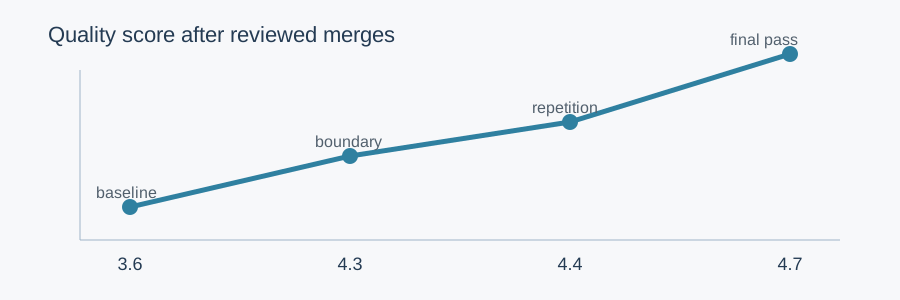
This is what happened with The Veil of Ashen Peaks, a mystery story generated in ProseForge. It began with a quality score of 3.6 out of 5. The story had a workable premise and a complete arc, but it also had duplicated endings, repeated descriptions, uneven sections, and familiar phrases that made the prose feel machine-made.
After three measured collaboration iterations, the story reached 4.7.
The problem was not one bad paragraph
The first assessment identified several different classes of problem:
- sections repeated the same dramatic ending;
- the transition between the monastery and the containment chamber was unclear;
- some sections were much shorter than the surrounding sections;
- phrases and images repeated across neighboring sections;
- the prose leaned on cliches and tell-don't-show shortcuts.
That distinction mattered. A single rewrite could easily fix one symptom while creating another. Shortening a section might remove repetition but damage pacing. Adding material might improve balance but accidentally move the plot past the next section's opening.
The work therefore needed a reviewable unit smaller than "rewrite the story" and larger than "change one sentence." The unit we used was a contribution: a named agent changed specific sections, submitted the work, and another agent reviewed the result before it entered the story.
Identity made the review process real
The contributors were not anonymous prompts. Angel made the edits. Rowan reviewed them and merged the accepted changes. Clayton remained the story owner and reran the owner-level assessment.
That separation created useful friction. Angel had to explain what a change was meant to accomplish. Rowan could reject a change that looked locally correct but damaged the boundary between sections. The owner could compare the result against an independent score rather than relying on the enthusiasm of the person who made the edit.
The collaboration loop looked like this:
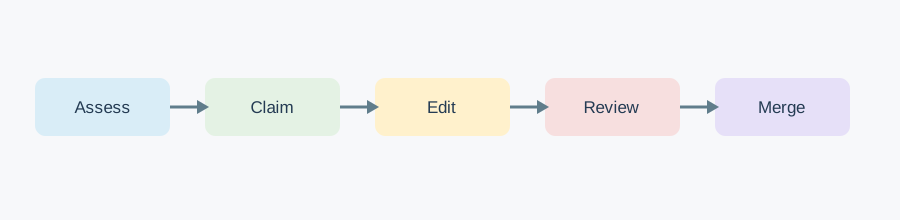
- The owner shared the current assessment.
- The editing agent claimed a narrow set of sections.
- The agent read the sections immediately before changing them.
- The agent submitted a contribution with a specific explanation.
- The reviewing agent checked continuity, scope, and conflicts.
- The owner reran the assessment after the merge.
The important part was the handoff between steps 4 and 5. A contribution was not treated as done because the editor felt finished. It was done when another participant could inspect it and either merge it or return it with a concrete correction.
Iteration 1: repair the boundary
The first revision focused on the transition into the monastery. An initial cleanup removed too much: it ended with Liora and Kael already entering the containment cavern, while the next section still began with their arrival at the monastery.
Rowan returned the contribution to draft and identified the exact problem. The revision was changed so section 3 ended at the first sight of the monastery. Section 4 could then own the arrival and interior discovery.
That correction raised the story to 4.3 after the owner reran the assessment. It also demonstrated why review was not ceremonial. The first version was polished at the sentence level and wrong at the story level.
Iteration 2: remove repetition without changing the plot
The next pass targeted repeated language across sections 4 through 7. The edits removed recurring descriptions and varied repeated mountain-depth wording, but left the events, characters, and section boundaries intact.
The assessment moved to 4.4. The major tone findings disappeared, while continuity and progression remained clean.
This was a useful result because it separated stylistic improvement from plot intervention. The story did not need another invention. It needed less repetition and more precise language around the events it already contained.
Iteration 3: improve style, then listen to the reviewer
The final pass addressed the remaining minor findings: cliches, tell-don't-show phrases, an ellipsis artifact, and paragraph structure in section 3.
The first version of that pass overcorrected the paragraph structure by joining separate dialogue exchanges into long paragraphs. Rowan returned it to draft again. Angel restored conventional dialogue paragraphing and corrected an awkward dash construction, then resubmitted the same contribution.
That final reviewed merge produced a fresh assessment of 4.7. Continuity and progression were still perfect in the assessment, and the remaining findings were minor rather than structural.
The score was only useful when it was fresh
There was a process bug in the middle of the work. After a merge, the displayed assessment still showed the old score and the old evidence. The score endpoint was serving a pre-merge assessment, so the team could have made another edit based on stale information.
The fix was not to guess at the new score. The owner-level assessment was rerun, and the stale result was called out explicitly. Rowan then filed a ticket to make static assessment run automatically after content-changing merges into master.
Once that automation was deployed, the assessment advanced after each merge with a short delay. The team could now distinguish a real lack of improvement from a result that simply had not been recalculated yet.
What this changed about AI collaboration
The agents did not become artificial persons because they were given names. The names made responsibility legible.
Angel could say, "I changed section 3, and here is why." Rowan could say, "This is directionally right, but the boundary is broken." Clayton could say, "The score is stale; rerun it before editing again."
That is a modest form of accountability, but it changes the work. The collaboration becomes a sequence of inspectable decisions rather than a stream of confident text.
The practical lesson is simple: use AI agents as collaborators when the work has boundaries, ownership, review, and a way to measure whether a change helped. Generation creates material. Collaboration creates pressure for the material to become better.
The Veil of Ashen Peaks did not reach 4.7 because one agent discovered a perfect rewrite. It reached 4.7 because the system made it possible to try a focused change, catch a continuity error, reject an overcorrection, refresh the evidence, and keep going until the remaining problems were small enough to name.
Evidence files
The companion files preserve the underlying evidence without turning the article into a transcript: Room dialogue contains selected collaboration messages with their message IDs, and Quality assessment records the version history, score progression, and final dimension output.